AUGMENTED SÁPMI
A Sápmi that never existed, that never will exist,
but that perhaps could have existed
Nadeschda Barenje, 2026
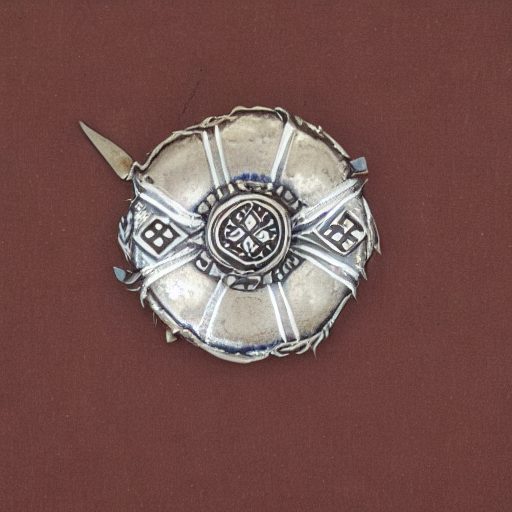
Why
I wanted to imagine a Sápmi that never was. An augmented Sápmi, reached through the paths it never travelled.
Somewhere in the generation a new version of Sápmi gets assembled, one that stands in relation to a lot of other cultures and never actually existed anywhere, something extended, added to.
I am not doing this to rebuild what was taken; that work belongs to museums and to Sámi makers, not to me. What pulls me is the opposite direction. The real tradition moved along certain routes, through certain hands and trade that colonisation mostly cut off, and I want to follow it the other way, to extend Sápmi along the paths it never took, the contacts that never happened, the versions that history never let it have.
The history
It was not only silver. Sámi things of every kind were taken, drums and knives, tools and textiles, work in horn and wood and bone, and what survived whole was scattered across fifty museums in three countries, no single collection holding more than a few hundred. Much never reached a museum at all. Metal that was melted down could be anywhere now, poured into new work, Sámi or otherwise, its origin gone in the furnace, and the drums the church seized were mostly burned rather than kept. The objects that did survive were lifted out of their own contexts once when they were taken, and then a second time in digitisation, spread across different databases with different formats and different rules.
The loss isn't only historical. A lot of people in Sweden with roots in the north have no idea they have Sámi ancestry at all, because generations of suppression and forced assimilation made families stop speaking of where they came from. What disappeared with these things was never only metal and cloth and wood, it was the knowledge of who made them and wore them and what they were for. There is a whole category of loss here that we do not even know we have lost.
The colonial gaze lives in the data
The model sees the way the West taught it to see, because it learned from millions of images that people had already tagged and filed according to their own categories. In that filing European art ended up with hundreds of separate labels for its periods and movements, while more or less everything indigenous was folded into one. Something from Jokkmokk and something from Juárez could land in the same folder, sorted as if they were the same kind of thing.
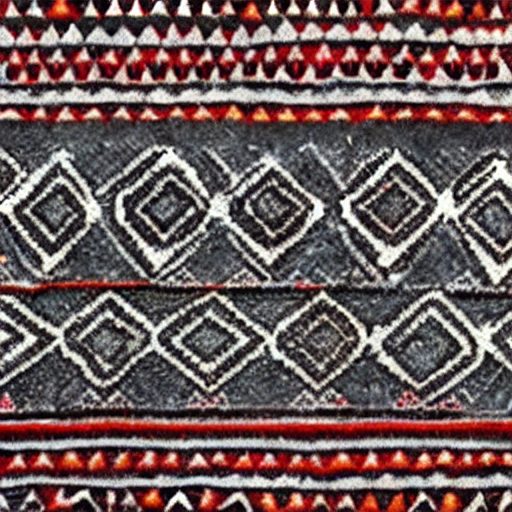
So when I ask it for something Sámi it works from that same flattening, mixing in carpets from Anatolia and embroidery from Guatemala because nothing in its training ever told it these were separate traditions. The bias people like to locate in the algorithm is really sitting further back than that, in the data and in how the archives were built and labelled long before any model came near them.
And this is where the wound becomes a road. The same filing that erased the line between Jokkmokk and Anatolia is the only thing left that lets them meet. Colonisation cut the trade routes; the archive, by folding everything into one drawer, accidentally reopens a contact that history forbade. None of this is a gift the archive meant to give, and the meeting it allows pays back nothing of what was taken. The flattening is a violence and an opening at the same time, one gesture seen twice, and the rest of this work lives inside that doubleness.
In the misreadings there is something else
What it builds instead is a Sápmi that never existed, with Anatolian edges and Andean colour and patterns that travelled through databases rather than along any real trade route. I have stopped reading these as failures and started reading them as versions, glimpses of a Sápmi that might have taken shape if contact between cultures had run some other way and the history had bent differently.
This augmented Sápmi only really exists in the narrow space between ten thousand museum photographs and whatever a machine assumes about them, and it belongs to a third place, beside what was real and what was lost.
Generated, projected, perceived
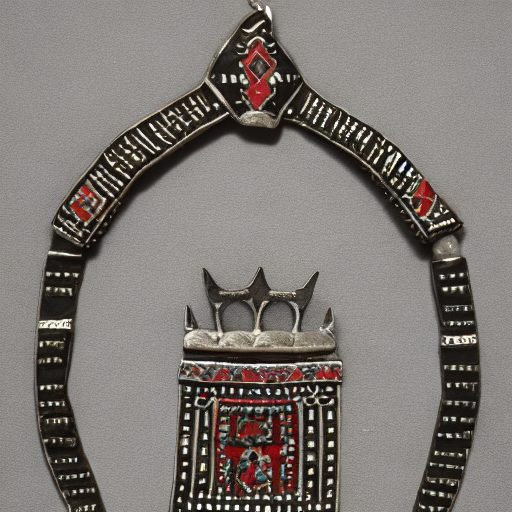
You work outward from the little that survived and the lot that you assume, filling the gaps in yourself, and that filling-in turns into its own kind of storytelling. The pieces end up as jewellery that was never allowed to exist in the first place, a late attempt to put something back where something had been taken away.
The method, step by step
A word on the machinery first, because the method is part of the meaning. Stable Diffusion is an image model trained on billions of pictures scraped off the open web. It learns by being shown an image, watching it dissolve into static, and practising the reverse, pulling a picture back out of noise. Ask it for something and it starts from pure noise and denoises its way toward whatever it thinks you mean. Everything it knows, and every assumption it carries, came from that pile of web images and the words people attached to them.
On its own it has barely looked at Sámi craft, so I added a LoRA. Low-rank adaptation is a small piece you train on top of the big model, in my case ten thousand museum photographs, and it nudges the whole thing toward one new thing without retraining it from scratch and without erasing what it already knew. It is light enough that the training ran on a single second-hand graphics card with six gigabytes of memory, sitting on my desk. From there I lean the model hard toward the Sámi form with the trigger word and watch it overshoot.
There is a cost here I want to name. Duodji is not a style, it is a regulated practice with its own rules of who may make what, and folding it into one machine token called sami_duodji repeats the exact flattening I am objecting to. I do it with my eyes open, because that flattening is what the work is trying to make visible.
- Gather the dataset. 10,002 photographs of Sámi objects, scraped from the open museum APIs K-samsök, DigitaltMuseum and Finna.fi, pulled together from Ájtte in Jokkmokk, Nordiska museet, Siida in Inari and roughly fifty institutions in all.
- Caption every image automatically with BLIP, so the model has words to attach to what it is seeing.
- Train a LoRA on Stable Diffusion 1.5 in full precision (fp16 kept collapsing into NaN), on the GTX 1660 Super, with sami_duodji as the trigger word.
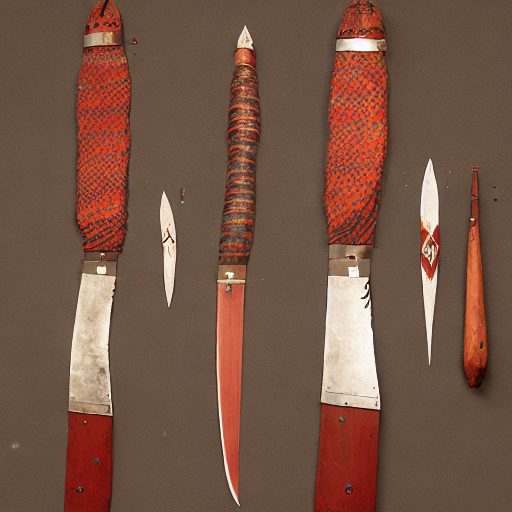
- Generate. More than 1,530 images, some left completely unprompted, others pushed toward objects, projections and knives.
- Select. Pull single objects out of the thousands of generations.
- Rebuild the chosen ones as 3D meshes with a text-to-3D AI, a second AI model trained on its own pile of web images, so the form passes through one more world on its way out of the flat picture. Then simplify them down for the browser and for printing.
- Print them physically and finish them by hand, patinating the surface.
Objects from the gap
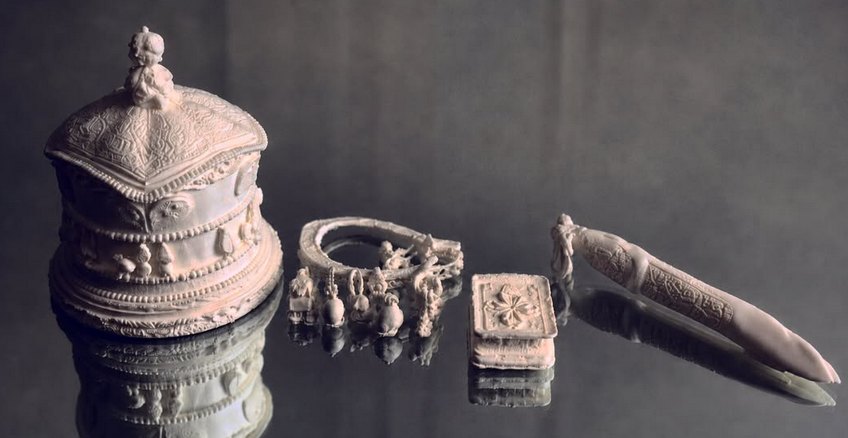
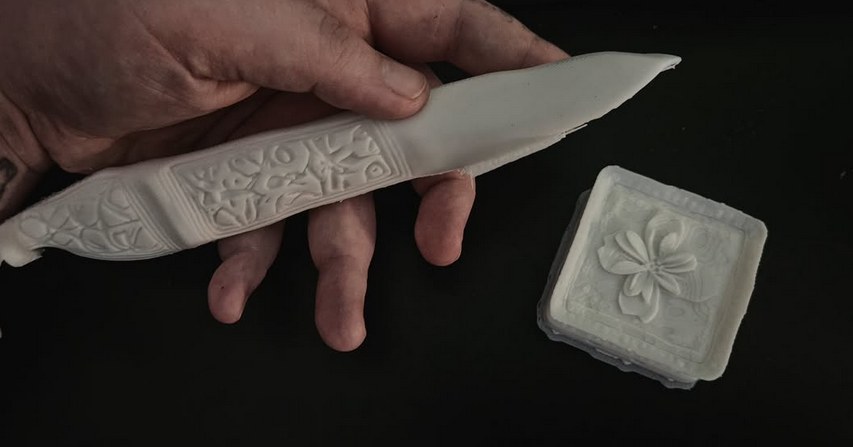
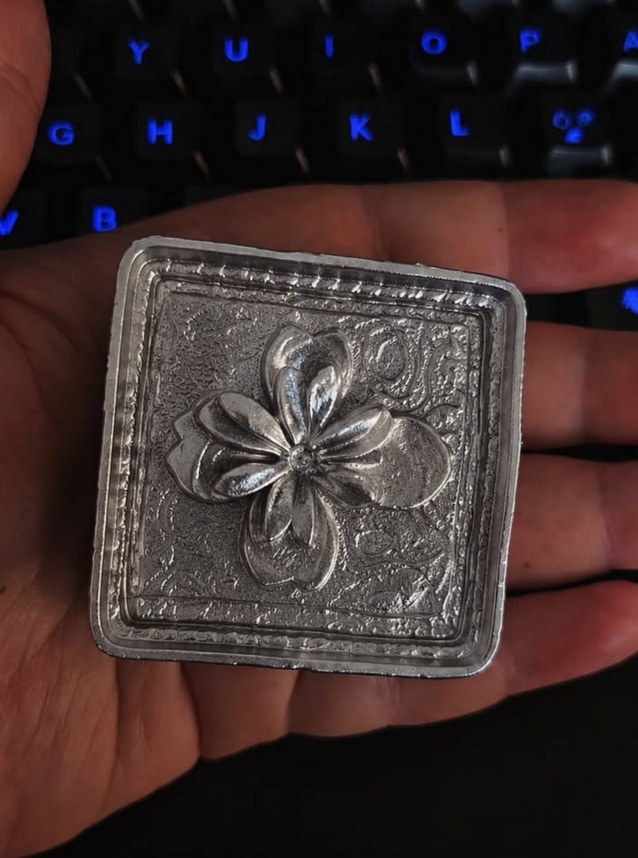
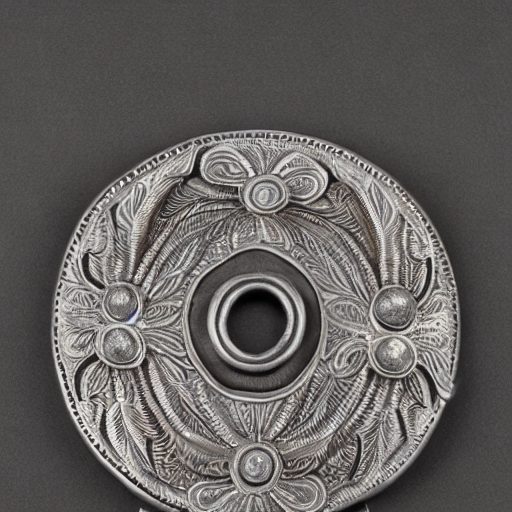
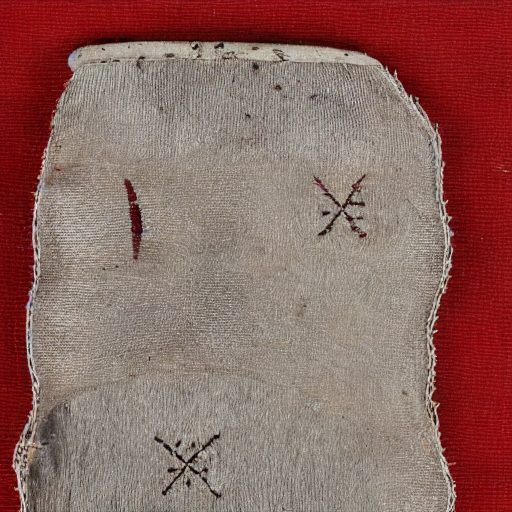
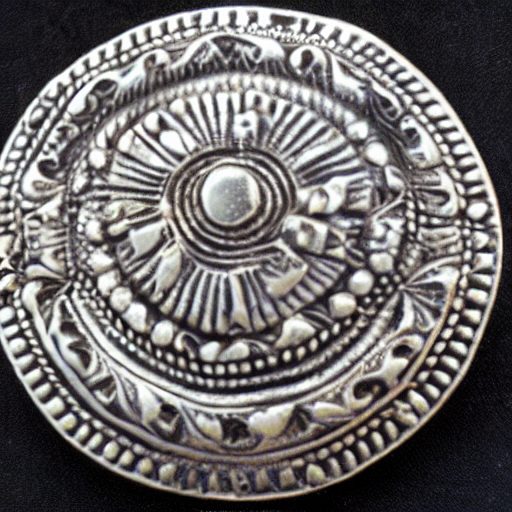
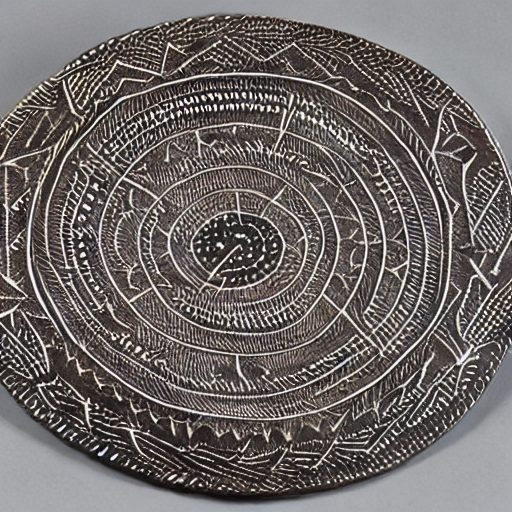
Every one of these is a composite of everything the model ever absorbed, so there is no original sitting behind any of them.
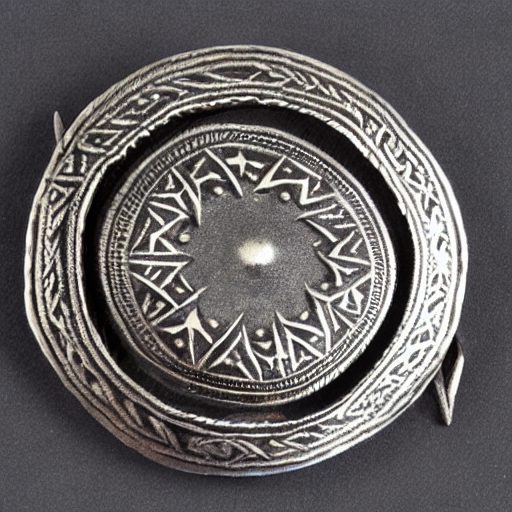
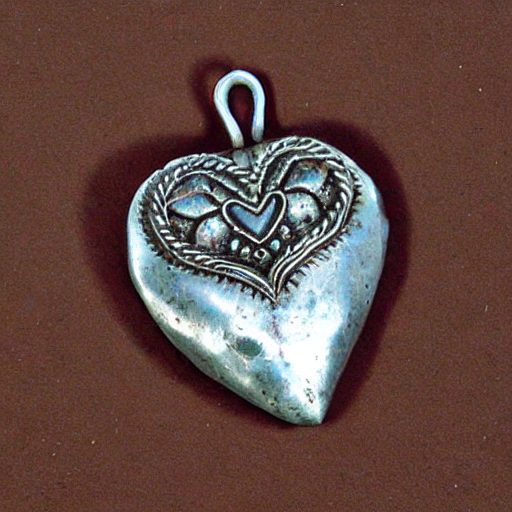
Knives
The knife keeps coming back. It turns up over and over in the collections, so the model has learned it well by now and keeps turning out new ones, none of which were ever sharpened on anything.
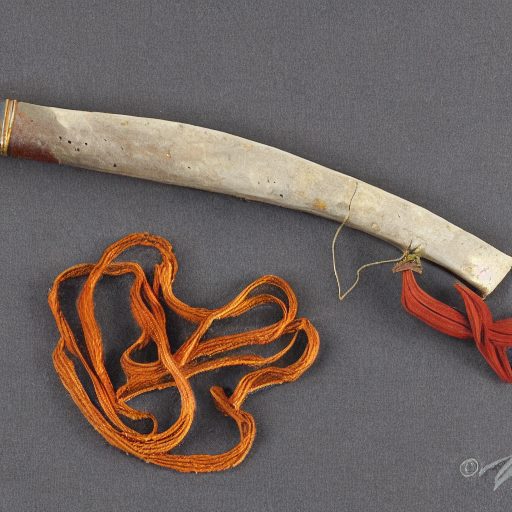
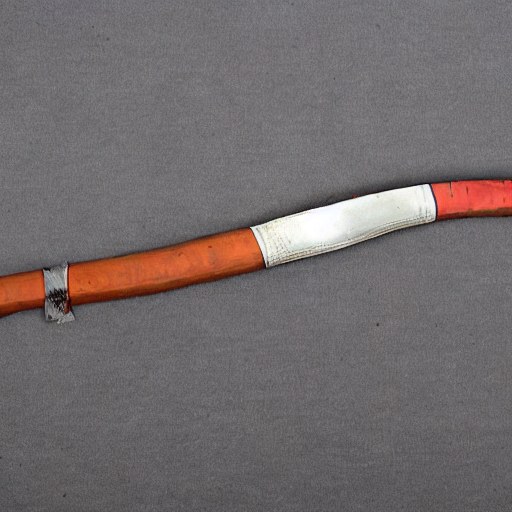
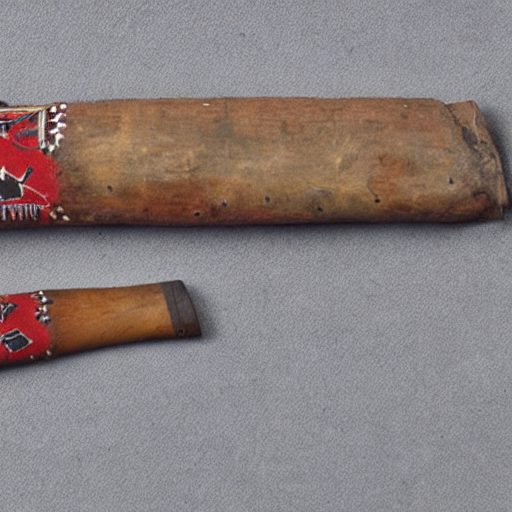
Turn them in your hands
These seven you can turn yourself, drag to rotate and scroll to zoom. When the software meshed them it also tried to name them, and the names it reached for came from everywhere except Sápmi, the same blending turning up in the language as in the forms, so I have kept the labels plain and descriptive instead. The object meets the world twice before it reaches your hands, once in the flat image and again in the mesh, and both times it comes back wearing things that were never Sámi.
One hundred from the run
A hundred images pulled more or less at random from across the whole run, free generations next to projected objects and knives and jewellery all mixed together. Click any of them to enlarge it. Nothing here was ever photographed or held by anyone, the model made all of it from the inside.
All images generated by the model. Training data from the open archives K-samsök, Finna.fi and DigitaltMuseum.
Technique
| Component | Specification |
|---|---|
| Base model | Stable Diffusion 1.5 (fp32) |
| Fine-tuning | LoRA, trigger word sami_duodji |
| Training data | 10,002 images from K-samsök, Finna.fi, DigitaltMuseum |
| Generated images | 1,530+ (unprompted, objects, projections, knives) |
| Carried into 3D | 7 meshes (text-to-3D AI), physical prints, hand-finished and patinated |
| GPU | NVIDIA GTX 1660 Super, 6 GB VRAM |
| Year | 2026 |
Position
This is sensitive territory and I want to be exact about where I stand in it. The dataset is the material culture of a people the state I hold citizenship in set out to erase, and training a model on it can be read as one more act of seizure, after the objects were already seized once. The usual way to manage that is a disclaimer, I am not Sámi. But it claims a certainty I do not actually have. The same suppression that scattered the objects, the forced assimilation that made families stop naming what they were, is the reason so many people with roots in the north cannot say whether they are Sámi or not. In my own family, when anyone asks, my father says no, and I take him at his word. What unsettles the question is a record that runs out: on his side the stories stop at my grandmother's parents, and beyond them it goes quiet. On my partner's side his grandmother is spoken of as perhaps having been Sámi, though there too it is mostly gaps. There are also roots in northern Russia that we know very little about, one more direction where the record thins out and goes quiet before it can be read. There are two objects in the family, a brooch and a knife, that reached us without their story, with no one left who can say where they were made or by whom. I cannot even say what the objects make us. They might have come down through kin, or been bought or taken the way so many Sámi things passed into Swedish and Norwegian hands. Inheritance or spoils, I have no way to tell the two apart. That unreadable inheritance, and the holes around it, is where this whole work began. I am somewhere inside that not-knowing. I am not claiming what is in the silence; I am saying I cannot read it. Not Sámi is not a fact I possess. It is a blank where a fact was removed.
So the work generates questions instead of replacements: what would have existed if nothing had been confiscated. The model meets a record full of holes and fills them with assumption, and I meet a family record with the same holes and the same silence, so the gap in the archive and the gap in me were cut by the same hand. To claim Sámi belonging would be a theft of its own; what I am doing instead is refusing the clean line between inside and outside, because the line was deliberately made unreadable, and that unreadability is the subject. The objects are speculations. They make no claim to authenticity or to belonging, and they answer only to the undecidable space the erasure produced.
The aim is to make the absence visible rather than to quietly paper over it, which is why I leave the errors in instead of cleaning them up. They are the shape of the archive showing through.
Source code
The training and generation code is at github.com/jinkieyz