Synecdoche of Care (2024)
Gjuten tenn och PLA, munblåst krombelagt glas, tennfontän, projektionCast tin and PLA, hand-blown chrome-coated glass, tin fountain, projection
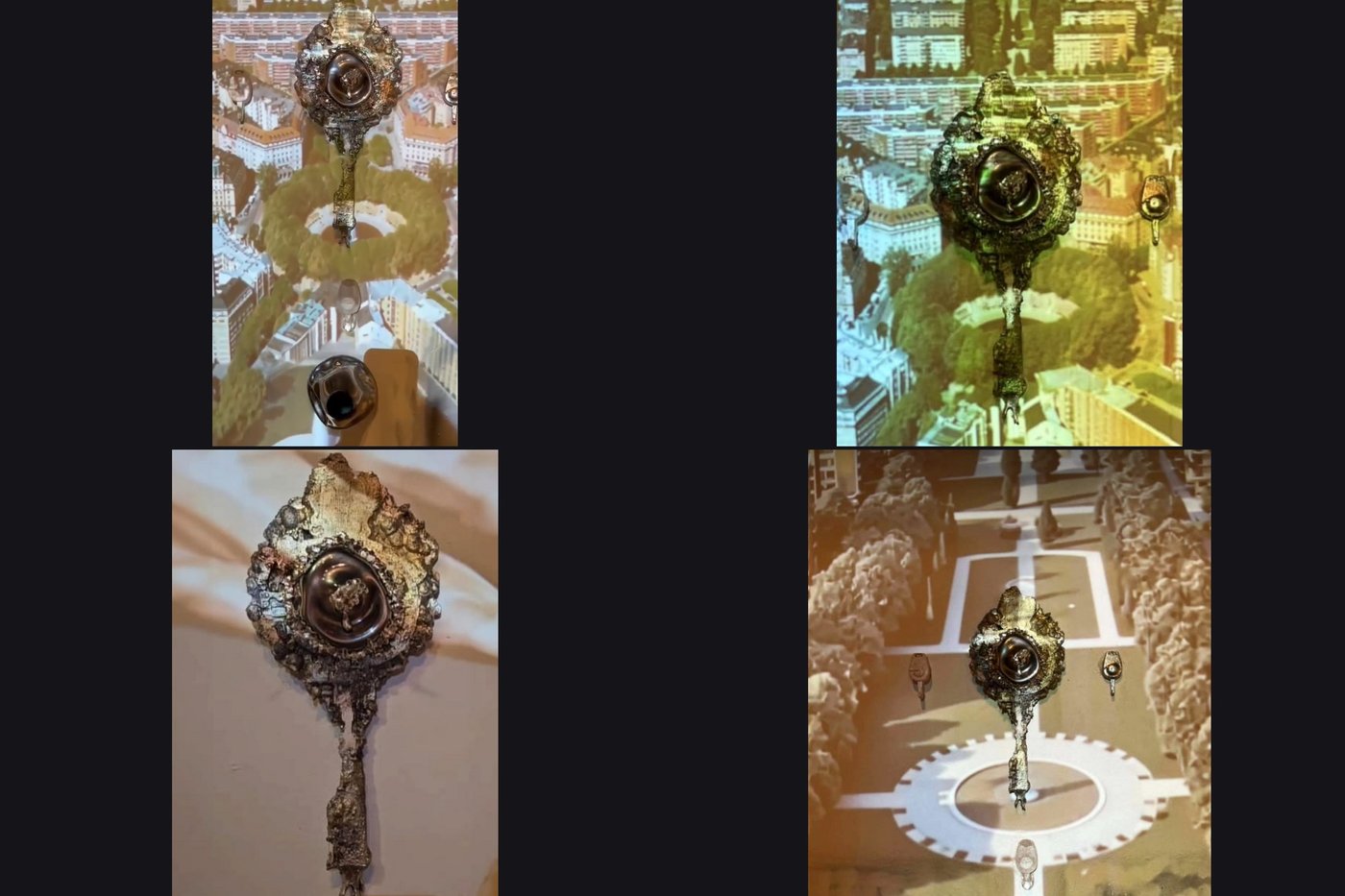
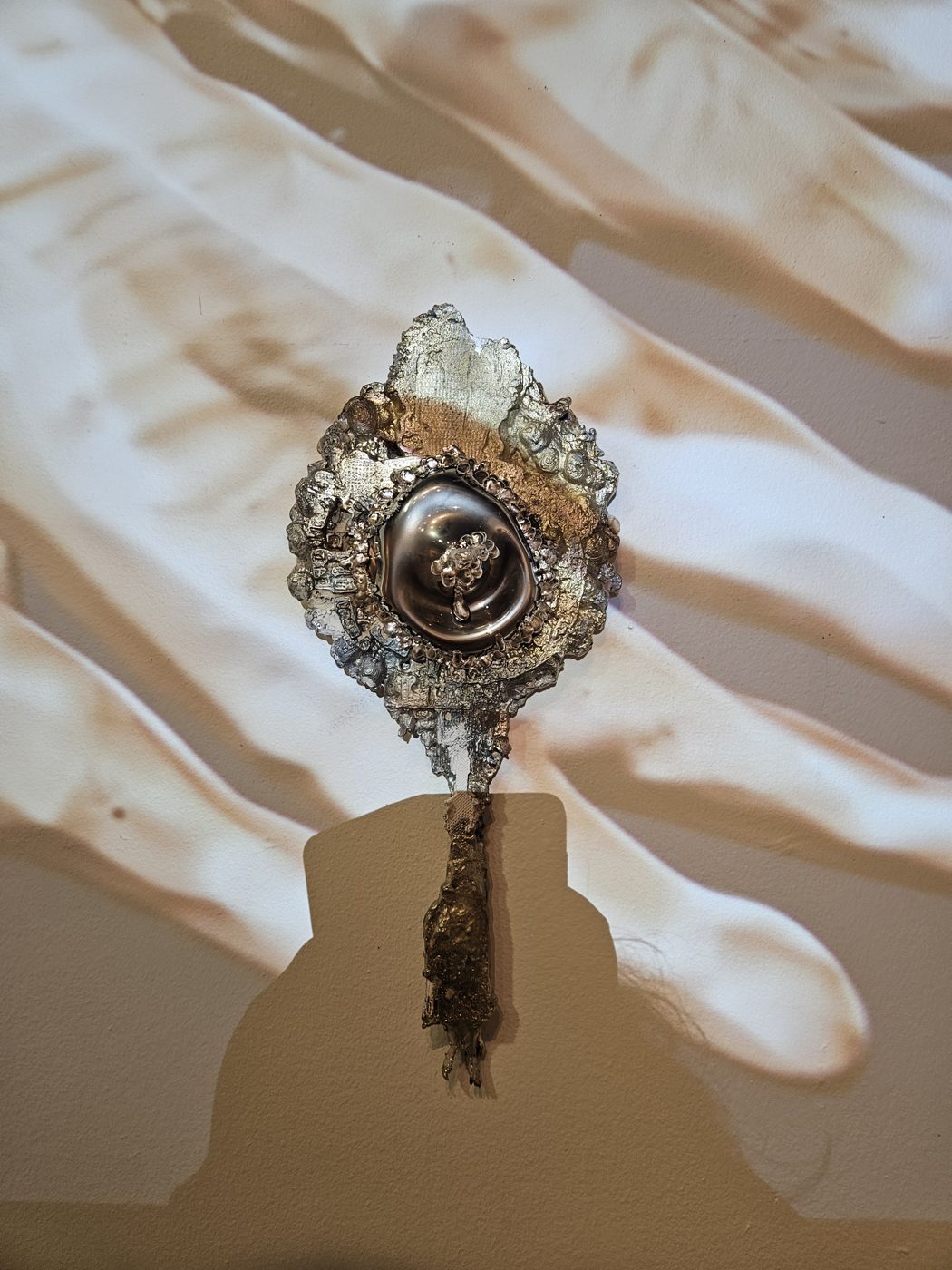
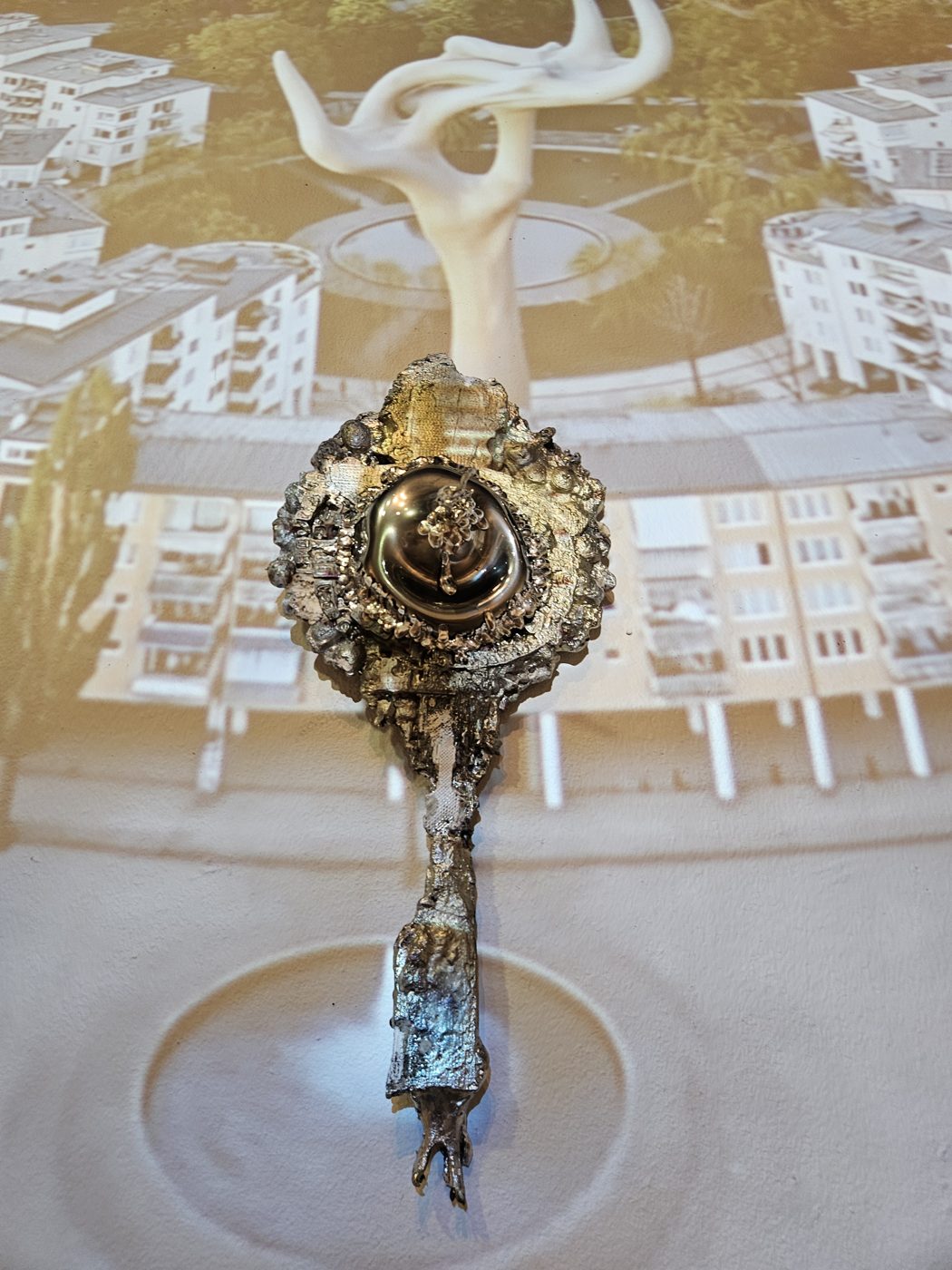
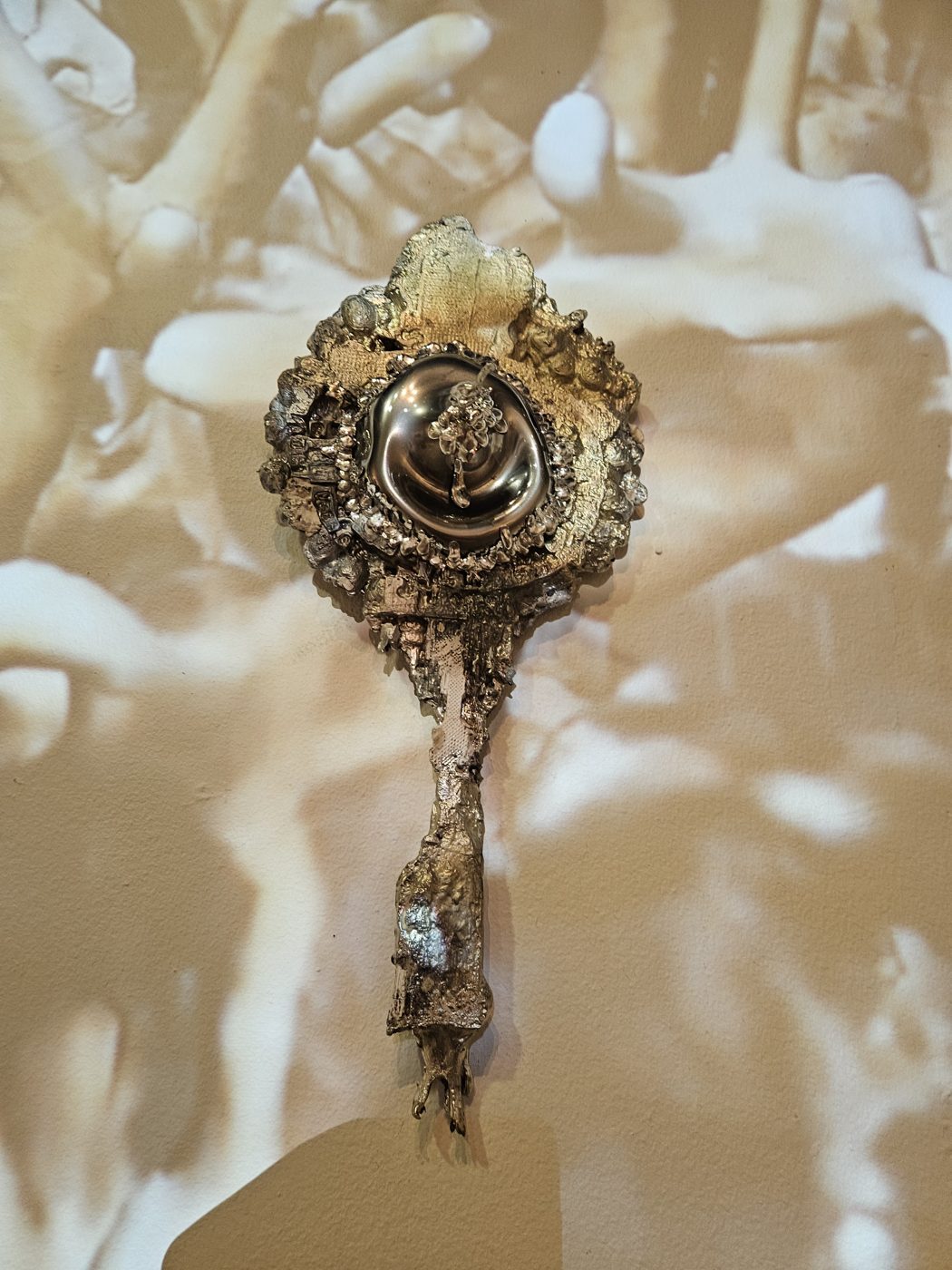
Synecdoche of Care är hela praktiken att ta hand om andra, hoppressad till ett enda objekt, delen som får stå för helheten. Verket är ett collage över de dementa jag hade i hemtjänsten. Ramen är gjuten i tenn, från en gjutform byggd på en 3D-modell av en topografisk karta. Samma karta återvänder i projektionen. Den är lagd av patienternas käraste minnen och platser, fontänerna vid Karlaplan, Tessinparken och Starrängsringen, ställen de berättade om, ställen de längtade till, ställen de höll fast vid när mycket annat lossnade.Synecdoche of Care is the whole practice of tending to other people pressed into a single object, the part left to stand for the whole. The work is a collage of the people with dementia I cared for in home care. Its frame is cast in tin, from a mould built on a 3D model of a topographic map. The same map returns in the projection. It is laid out from the patients' dearest memories and places, the fountains at Karlaplan, Tessinparken and Starrängsringen, places they told me about, places they longed for, places they held on to when much else came loose.
Formen till ramen skrev jag ut i PLA, men jag avbröt utskriften ungefär tre fjärdedelar in, som en tanke som hakar upp sig och stannar. Man kan precis skönja motivet, kartan, terrängen, men den är inte färdig, den bröts mitt i. Plasten fick sitta kvar i formen när jag gjöt, och materialen gick samman, PLA och tenn i samma kropp. Det är så jag tänker på minnet hos dem jag tog hand om, en bild som börjar teckna sig men aldrig blir hel, ett motiv man anar men inte kan följa hela vägen. Ramen och videon kommer ur samma 3D-modell: det jag skrev ut och gjöt är samma karta som projiceras, det fysiska och det digitala ur en och samma källa.I printed the mould for the frame in PLA, but I stopped the print about three quarters in, like a thought that catches and halts. You can just make out the motif, the map, the terrain, but it is not finished, it broke off midway. The plastic was left sitting in the mould when I cast, and the materials merged, PLA and tin in the same body. That is how I think of the memory of the people I cared for, an image that begins to take shape but never becomes whole, a motif you can sense but cannot follow all the way. The frame and the video come from the same 3D model: what I printed and cast is the same map that is projected, the physical and the digital from one and the same source.
Jag la ut dem som en rutt och räknade fram den optimala vägen mellan dem, den kortaste rundan där jag ändå hann med alla. Så fungerar hemtjänsten. Du får ett schema och en karta och för lite tid, och du rusar mellan portarna, låser upp, hälsar, hjälper, låser, springer vidare, försöker hinna med allihop innan dagen tar slut. Omsorgen mäts i minuter. Kartan är gjord av den stressen lika mycket som av deras minnen, en rutt där ömhet och effektivitet inte går att skilja åt.I set them out as a route and worked out the optimal path between them, the shortest round where I still reached everyone. That is how home care works. You are given a schedule and a map and too little time, and you rush between the doors, unlock, greet, help, lock, run on, trying to reach them all before the day runs out. Care is measured in minutes. The map is made of that stress as much as of their memories, a route where tenderness and efficiency cannot be told apart.
Längst ner på kartan börjar rutten vid min gammelmormors port. Hon var död. Mitt emot hennes port låg porten till en av patienterna, också död. Jag växte upp på Östermalm och kom tillbaka dit för att ta hand om äldre som var släkt med dem jag gått i skolan med. Rutten går rakt mellan liv och död, mellan minne och omsorg, och jag gick den varje dag utan att riktigt hinna se den.At the bottom of the map the route begins at my great-grandmother's gate. She was dead. Across from her gate stood the gate of one of the patients, also dead. I grew up on Östermalm and came back to care for elderly people who were relatives of those I went to school with. The route runs straight between life and death, between memory and care, and I walked it every day without quite having time to see it.
Nu har jag ingen tillgång till de här platserna och minnena längre. Portarna är stängda. Människorna är borta. Jag går bara förbi, känner igen en dörr, en trappuppgång, en fontän, men kommer inte in. Minnena är inte mina, jag bara bar dem en stund. Det enda jag har kvar är kartan.Now I no longer have access to these places and memories. The gates are closed. The people are gone. I only walk past, recognise a door, a stairwell, a fountain, but I do not get in. The memories are not mine, I only carried them for a while. All I have left is the map.
Därför bygger jag den som ett rhizom. Minnet är inte en linje från då till nu, det är ett nät utan mitt och kant, där saker sjunker undan och kommer tillbaka på andra ställen, i andra former. Varje gång ett minne återvänder är det lite förvrängt, lite mindre likt det som en gång var. Videon blandar två sorters material: 3D-modeller som jag skannat in fysiskt, det som verkligen fanns, och AI-renderingar gjorda ur fotografier, det maskinen fyller i. Det skannade och det påhittade ligger sida vid sida och rekonstruerar fontänerna längs rundan, precis som i ett minne där det man varit med om och det man lagt till flyter ihop. Men rekonstruktionen är i sig en förvrängning av människan, en maskin som bygger upp platser den aldrig levt i och ger tillbaka en avbild som liknar men vrider sig. Det är samma rörelse som minnets, fel, ungefärligt, hela tiden omformat. Spegeln är munblåst, krombelagt glas som fångar de förvrängda, fragmenterade bilderna. I mitten står en skör tennfontän, minnets rörelse, konstant men aldrig densamma, som vattnet som fyller och formar den.So I build it as a rhizome. Memory is not a line from then to now, it is a net with no centre and no edge, where things sink away and come back somewhere else, in other forms. Every time a memory returns it is a little distorted, a little less like what once was. The video mixes two kinds of material: 3D models I scanned in physically, what was really there, and AI renderings made from photographs, what the machine fills in. The scanned and the invented sit side by side, reconstructing the fountains along the round, just like a memory where what you lived and what you added blur together. But the reconstruction is itself a distortion of the human, a machine building up places it never lived in and handing back a likeness that resembles yet twists. It is the same movement as memory's, wrong, approximate, endlessly reshaped. The mirror is hand-blown, chrome-coated glass, catching the distorted, fragmented images. At its centre stands a delicate tin fountain, the movement of memory, constant yet never the same, like the water that fills and shapes it.